
Why European Procurement Teams Will Demand Brazilian Evidence Before Price
Villanova ESG Executive Dossier
Why European Procurement Teams Will Demand Brazilian Evidence Before Price
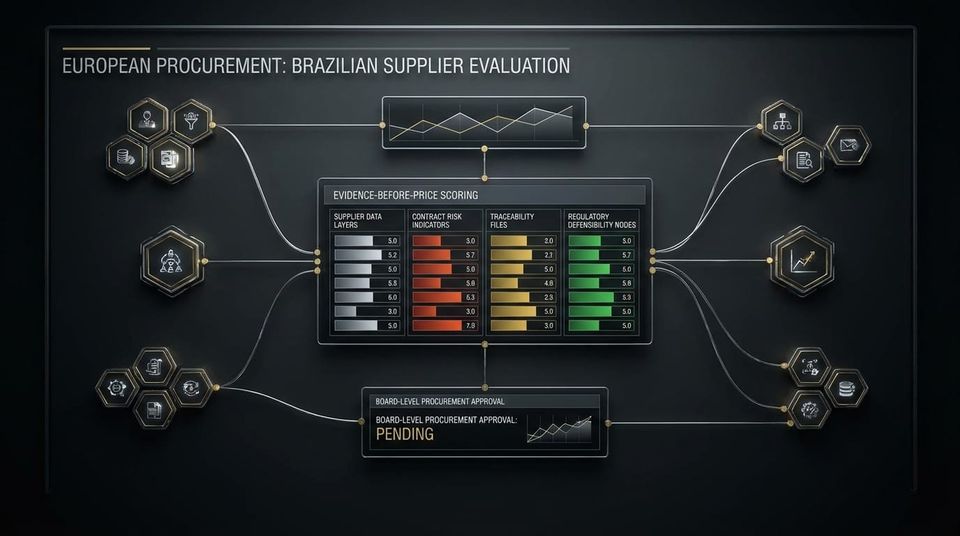
European procurement is shifting from price-first supplier selection to evidence-based supplier defensibility. For Brazilian companies connected to EU-facing chains, price will still matter. But before price becomes decisive, buyers will increasingly ask whether the supplier can defend origin, emissions, traceability, documentation and regulatory exposure.
Risk Class
EU-facing procurement, supplier evidence and buyer-readiness exposure.
Financial Channel
Supplier qualification, contract renewal, margin leverage and revenue continuity.
Evidence Trigger
Traceability, supplier risk, emissions data, origin documentation, contract evidence and board-readable files.
Executive Signal
For years, Brazilian suppliers competed in international procurement through price, volume, quality, delivery capacity and commercial relationships.
Those variables remain relevant.
But European procurement is changing.
Large buyers are under increasing pressure from due diligence obligations, sustainability reporting expectations, investor scrutiny, lender questions, product regulations, carbon exposure and board-level governance.
That pressure changes supplier selection.
The buyer’s question is no longer only: “Who can deliver at the best price?”
The buyer’s question is becoming: “Which supplier can we approve, document and defend?”
The CFO Problem
A CFO does not manage procurement as a price table alone. A CFO manages supplier risk, continuity, margin protection and exposure transferred into the company’s balance sheet.
When a supplier is cheap but evidentially weak, the buyer may inherit hidden costs.
- Legal review may delay supplier approval.
- Compliance teams may request additional documentation.
- Contracts may include tighter audit, traceability and reporting clauses.
- Procurement may exclude suppliers that cannot support buyer reporting obligations.
- Finance may price supplier uncertainty into risk controls.
- Boards may question sourcing decisions that cannot be defended.
The financial issue is not whether the supplier is inexpensive. The financial issue is whether the supplier creates unpriced risk after selection.
Why Procurement Is Becoming Evidence-First
European procurement teams sit at the point where regulatory pressure meets supplier reality.
They must buy products and services. But they also need to reduce exposure for legal, compliance, finance, sustainability, audit and board stakeholders.
This makes procurement a risk gatekeeper.
In EU-facing procurement, the supplier that cannot produce evidence becomes harder to approve, even when its price is attractive.
CSDDD, CSRD, EUDR, CBAM, packaging rules, product-data requirements and sector-specific buyer obligations all push procurement toward stronger supplier files.
These regimes are different. They should not be simplified into a generic ESG checklist.
The common operational result is clear: supplier evidence becomes part of purchasing discipline.
The Supplier Evidence Gap
Many Brazilian suppliers have operational strength. Fewer have buyer-ready evidence architecture.
This distinction matters.
Operational strength may include production capacity, logistics experience, supplier relationships, technical capability, cost efficiency and commercial history.
Buyer-ready evidence requires more.
It requires documents, data, governance and explanation that a European buyer can use internally.
The evidence gap appears when a supplier can deliver the product but cannot support the buyer’s risk file.
That gap can weaken negotiation leverage even before a formal compliance issue exists.
Financial Risk Formula
Procurement evidence exposure can be structured as a supplier selection and revenue-risk model.
Supplier Evidence Selection Risk
SESR = ER × EG × BI × PA
- ER = EU-facing revenue exposed to buyer procurement decisions.
- EG = Evidence gap across traceability, emissions, origin, supplier risk and documentation.
- BI = Buyer intensity of due diligence, reporting, audit and contract requirements.
- PA = Procurement action risk through delay, exclusion, renegotiation, substitution or margin pressure.
This formula cannot be calculated responsibly without internal company data.
Required inputs include revenue by buyer, buyer concentration, product categories, contract renewal dates, supplier documentation maturity, traceability coverage, emissions data, origin evidence, audit history, buyer questionnaires, contractual obligations and procurement decision timelines.
The logic is direct: when EU-facing revenue is material and evidence gaps are high, procurement risk becomes a cash-flow protection issue.
The Procurement-Readiness Test
A Brazilian supplier becomes procurement-ready when it can support the European buyer’s internal approval file without improvisation.
The essential questions are direct:
- Buyer Exposure: Which European or EU-linked customers are material to revenue?
- Product Scope: Which products or services create regulatory or supply-chain evidence demands?
- Traceability: Can origin, supplier chain, handling and destination be documented?
- Emissions Data: Can climate or carbon-related data be provided where requested?
- Supplier Risk: Are upstream suppliers mapped, assessed and documented?
- Contract Evidence: Can the company comply with audit, reporting, due diligence and data-sharing clauses?
- Governance: Can the evidence be reviewed by procurement, legal, compliance, finance and board stakeholders?
The supplier that prepares this file early does not only reduce risk.
It improves commercial posture.
Decision Trigger for CFOs
A CFO should escalate procurement evidence exposure when one or more of the following conditions exist:
- The company sells to European buyers or EU-linked multinational groups.
- Revenue concentration in a small number of buyers is material.
- Buyers request due diligence, traceability, emissions, product, origin or supplier-risk documentation.
- Procurement questionnaires are answered manually, inconsistently or without evidence control.
- Contracts include audit, ESG, reporting, traceability, data-sharing or compliance clauses.
- Supplier documentation is dispersed across operations, legal, finance, logistics and commercial teams.
- Price competitiveness is strong but evidence quality is weak.
- The board cannot review a clear buyer-readiness and procurement-risk file.
The trigger is not a lost contract. The trigger is weak evidence before procurement decides.
The Strategic Role of Villanova ESG
Villanova ESG does not replace legal counsel, auditors, certification bodies, technical laboratories, customs advisors, procurement consultants, financial advisors or regulatory authorities.
Its role is to translate Brazilian operational reality into European-facing evidence architecture that can be understood by buyers, CFOs, procurement teams, compliance officers and boards.
For procurement exposure, this means structuring documentation around buyer requirements, product scope, supplier risk, traceability, emissions data, contract obligations, response timing and financial-risk interpretation.
The objective is not to promise buyer approval, contract renewal, market access or regulatory clearance. The objective is to improve regulatory defensibility, buyer-readiness and commercial credibility.
Price opens the conversation. Evidence keeps the supplier in the room.
What Brazilian Suppliers Should Prepare
Preparation should begin before a European buyer sends an urgent supplier questionnaire.
Once procurement controls the timeline, the supplier is already reacting from a weaker position.
- EU-facing buyer and revenue exposure map.
- Product and service regulatory exposure matrix.
- Supplier documentation and traceability review.
- Emissions, origin, product or destination evidence where applicable.
- Procurement questionnaire response file.
- Contract review for audit, ESG, reporting and data-sharing obligations.
- Evidence gap analysis by buyer and product category.
- Internal responsibility matrix for evidence ownership.
- Buyer-facing evidence package.
- Board-readable procurement risk memorandum.
This preparation is not administrative excess. It is revenue-continuity infrastructure.
Regulatory Source Trail
This dossier is based on official and institutional regulatory references, including:
- European Commission — Corporate Sustainability Due Diligence Directive.
- Directive (EU) 2024/1760 on corporate sustainability due diligence.
- European Commission — Corporate Sustainability Reporting Directive materials.
- European Commission — Value-chain sustainability reporting and supplier information policy materials.
- Official EU materials on due diligence, value-chain accountability, supplier information, product data, emissions reporting and procurement-related evidence pressure.
No legal, audit, procurement, financing, buyer-approval or market-access guarantee is implied. Company-specific conclusions require review of contracts, buyer requirements, product categories, supplier data, operational evidence, reporting scope and applicable regulatory exposure.
Executive Review
European procurement is shifting from price-first selection to evidence-first defensibility.
The Brazilian suppliers that treat this as bureaucracy will remain exposed. The suppliers that treat evidence as procurement-readiness infrastructure will be better positioned.
Villanova ESG supports companies that need to translate Brazilian operational reality into European-facing regulatory evidence, board-level documentation and buyer-readiness architecture.
contact@villanovaesg.com