
Why “Compliant” Is Not Enough Without Audit-Grade Documentation
Risk & Compliance Memo
Why “Compliant” Is Not Enough Without Audit-Grade Documentation
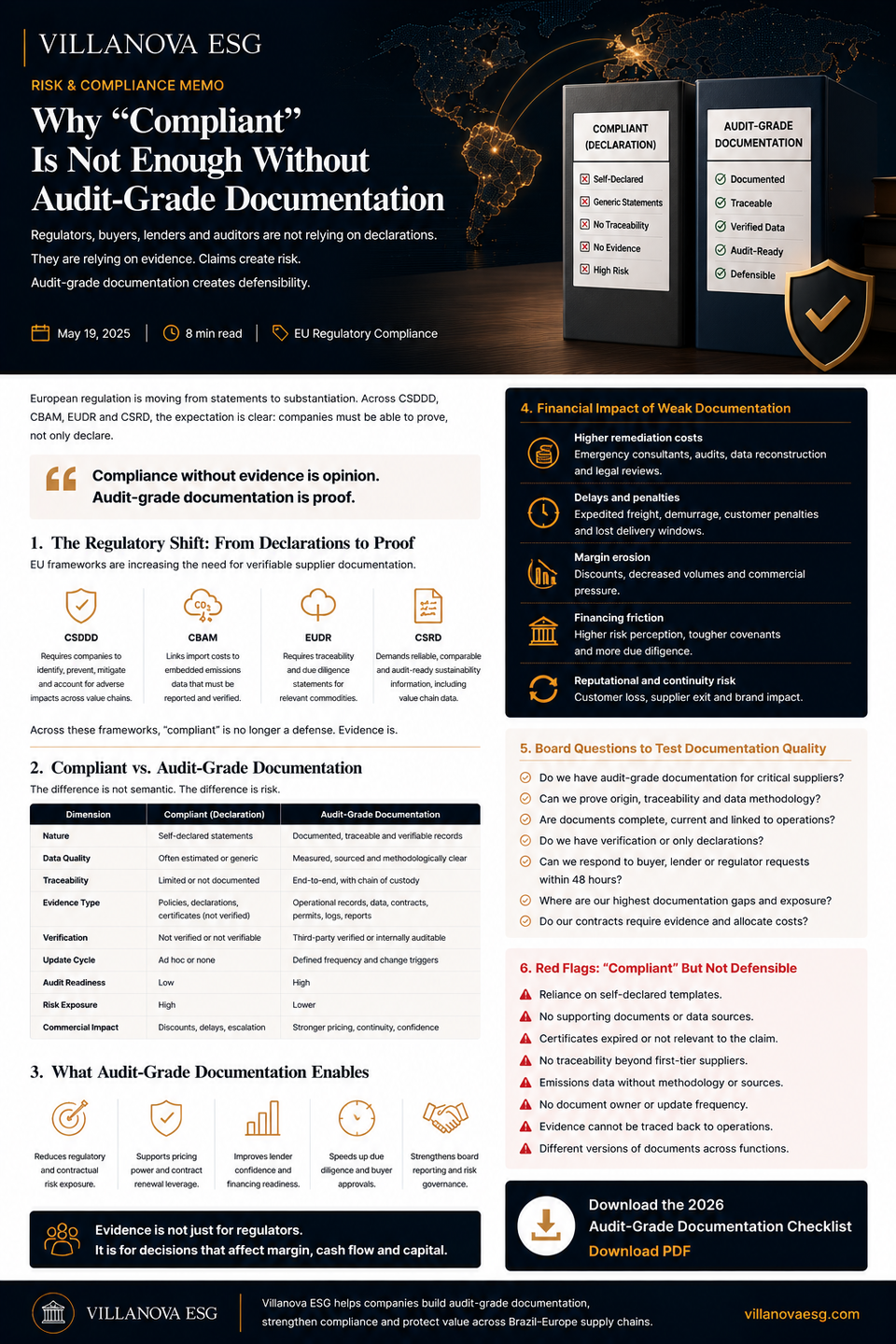
Regulators, buyers, lenders and auditors are not relying on declarations. They are relying on evidence. Compliance claims create risk when documentation cannot prove them.
Core Risk
Unsupported Claims
Evidence Standard
Audit-Grade
CFO Exposure
Defensibility Cost
Executive Thesis
Many suppliers and companies describe themselves as compliant. That statement has limited value unless it can be supported by current, traceable, verifiable and reviewable documentation.
In Brazil-Europe supply chains, the risk is not only whether a company believes it is compliant. The risk is whether a buyer, lender, auditor, regulator or board can verify the evidence behind that position.
Compliance without evidence is opinion. Audit-grade documentation is proof.
The strategic question is not “Are we compliant?” The board-level question is “Can we prove the position under external scrutiny?”
The Regulatory Shift: From Declarations to Proof
The Corporate Sustainability Due Diligence Directive entered into force on 25 July 2024. The European Commission states that the directive aims to foster responsible corporate behaviour across companies’ operations and global value chains, with companies in scope identifying and addressing adverse human rights and environmental impacts. This makes declarations insufficient without underlying due diligence evidence. :contentReference[oaicite:0]{index=0}
CBAM also moves companies toward proof. The European Commission describes CBAM as a system to confirm that a price has been paid for embedded carbon emissions generated in the production of certain goods imported into the EU. That confirmation depends on data and documentation, not generic climate statements. :contentReference[oaicite:1]{index=1}
CSRD increases pressure on documentation quality because companies subject to CSRD have to report according to European Sustainability Reporting Standards. Reporting requires structured, consistent and reviewable information. :contentReference[oaicite:2]{index=2}
OECD due diligence guidance reinforces the same logic: companies are expected to map operations, suppliers and business relationships relevant to prioritized risk and catalogue applicable standards, laws and frameworks. :contentReference[oaicite:3]{index=3}
“Compliant” vs. Audit-Grade Documentation
The difference is not semantic. The difference is risk.
| Dimension | “Compliant” Declaration | Audit-Grade Documentation |
|---|---|---|
| Nature | Self-declared statement. | Documented, traceable and verifiable records. |
| Data Quality | Often generic, estimated or unsupported. | Sourced, methodologically clear and connected to operations. |
| Traceability | Limited, informal or not documented. | Chain-of-custody, source records, operational files and responsibility owners. |
| Verification | Difficult to test. | Reviewable by buyer, lender, auditor or authorized third party. |
| Update Cycle | Ad hoc, unclear or absent. | Defined frequency, owner, validity control and change triggers. |
| Business Value | May support marketing but weak under scrutiny. | Supports buyer-readiness, contract leverage, lender review and board defensibility. |
What Audit-Grade Documentation Requires
1. Document Ownership
Every key document must have an accountable owner, validity date, update cycle and escalation process.
2. Traceability Link
Evidence must connect to actual operations, suppliers, materials, products, logistics flows or data sources.
3. Data Methodology
Companies must explain how data is measured, estimated, sourced, calculated, reviewed or verified.
4. Evidence Room Structure
Documentation should be organized by risk, supplier, product, regulation, claim or decision use — not scattered across folders.
5. Gap Register
Missing, expired, weak or unverifiable evidence should be tracked with owners, deadlines and remediation priority.
6. External Response Capability
The company should be able to respond to buyer, lender, auditor, investor or regulator requests without emergency reconstruction.
CFO Formula for Documentation Defensibility
Audit-grade documentation should reduce the probability and cost of evidence failure.
Documentation Defensibility = Evidence Quality × Traceability × Verification × Governance Ownership
This model requires internal company data. Inputs include evidence maturity, document validity, supplier criticality, data methodology, response time, remediation cost and stakeholder scrutiny.
Compliance Claim Risk = Claim Visibility × Evidence Gap × External Scrutiny × Remediation Cost
If the evidence gap is high, the compliance claim becomes a risk multiplier.
Financial Impact of Weak Documentation
- Higher remediation costs: emergency consultants, audits, data reconstruction and legal reviews.
- Delays and penalties: expedited freight, demurrage, missed windows and customer penalties.
- Margin erosion: discounts, decreased volumes and weaker commercial leverage.
- Financing friction: higher risk perception, tighter covenants and more due diligence.
- Reputational exposure: buyer concern, public scrutiny and board escalation.
- Continuity risk: supplier suspension, non-renewal or forced replacement.
Red Flags: “Compliant” But Not Defensible
- Reliance on self-declared templates.
- No supporting documents or data sources.
- Certificates expired, irrelevant to the claim or disconnected from operations.
- No traceability beyond first-tier suppliers.
- Emissions, product, land-use or supplier data without methodology.
- No document owner, update frequency or validity control.
- Evidence cannot be traced back to operational records.
- Different departments use different versions of the same documentation.
Decision Trigger for CFOs and Boards
Do not approve the word “compliant” unless the evidence can survive review.
Replace declarations with audit-grade documentation, evidence ownership, traceability and a clear response process.
The CFO’s role is to treat weak documentation as financial exposure. If the company cannot prove the claim, the claim should not be relied on for buyers, lenders, investors or board decisions.
Villanova ESG Position
Villanova ESG helps companies move from compliance claims to audit-grade documentation for Brazil-Europe supply chains.
The objective is not to promise compliance, guarantee legal certainty or replace legal counsel. The objective is to structure evidence architecture, supplier documentation and board-level defensibility so companies can prove what they rely on.
In regulated markets, being compliant is not enough. Being able to prove it is the control.
Regulatory Source Trail
- European Commission — Corporate Sustainability Due Diligence Directive: Directive 2024/1760 entered into force on 25 July 2024 and aims to foster responsible corporate behaviour across operations, subsidiaries and global value chains.
- European Commission — Carbon Border Adjustment Mechanism: CBAM is designed to confirm that a price has been paid for embedded carbon emissions generated in the production of certain goods imported into the EU.
- European Commission — Corporate Sustainability Reporting: companies subject to CSRD must report according to European Sustainability Reporting Standards.
- OECD — Due Diligence Guidance for Responsible Business Conduct: companies are expected to map operations, suppliers and business relationships relevant to prioritized risk and catalogue applicable standards, laws and frameworks.
Executive Review
Replace compliance claims with audit-grade evidence.
Villanova ESG supports CFOs, Boards and supplier-facing teams with audit-grade documentation frameworks, evidence rooms and regulatory defensibility for Brazil-Europe supply chains.
For private board-level briefings: contact@villanovaesg.com