
When a Supplier Becomes a Regulatory Liability, Not a Cost Center
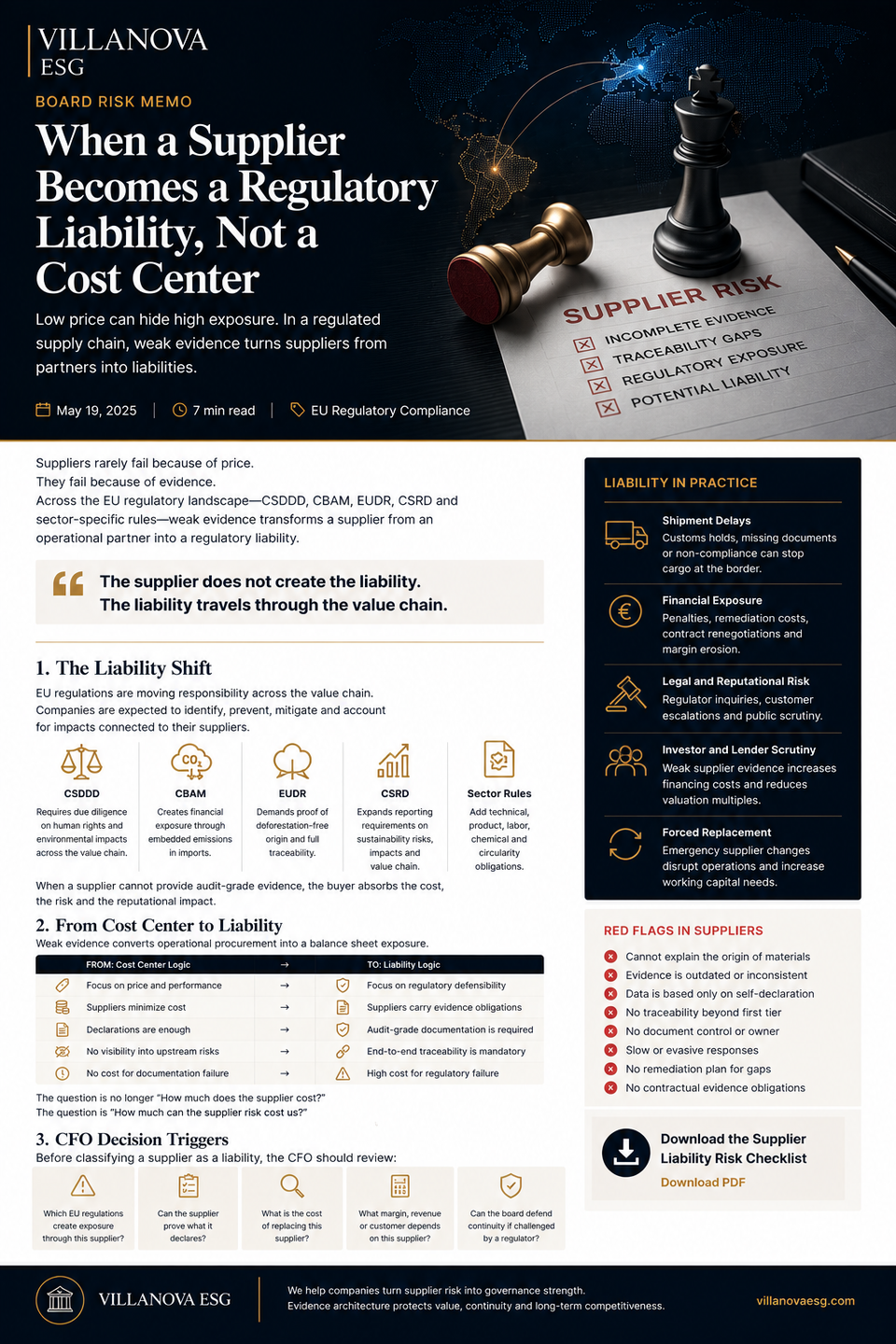
Board Risk Memo
When a Supplier Becomes a Regulatory Liability, Not a Cost Center
A supplier is not cheap if its evidence is weak. In Brazil-Europe supply chains, poor documentation can convert low-cost procurement into regulatory liability, margin exposure and board-level risk.
Supplier Lens
Liability, Not Price
CFO Exposure
Cost Transfer
Board Question
Defend or Replace
Executive Thesis
Procurement often classifies suppliers through cost, performance, quality and delivery reliability. That model is now insufficient for cross-border trade into Europe.
A supplier may be operationally efficient and commercially attractive while still creating regulatory exposure for the buyer.
The supplier does not need to fail operationally to become a liability. It only needs to fail evidentially.
For EU companies sourcing from Brazil, supplier risk must be assessed through evidence maturity, regulatory relevance, traceability, contract leverage and replacement economics.
The core CFO question is no longer: how much does this supplier cost? The correct question is: how much exposure does this supplier transfer to us?
Why Supplier Liability Is Expanding
EU regulatory pressure is moving across the value chain. The Corporate Sustainability Due Diligence Directive entered into force on 25 July 2024 and is designed to address adverse human rights and environmental impacts across companies’ own operations, subsidiaries and global value chains. That makes supplier relationships relevant to governance and due diligence, not just procurement.
CBAM also changes the economics of covered imports. The European Commission describes the mechanism as a system to confirm that a carbon price has been paid for embedded emissions generated in the production of certain goods imported into the EU. Supplier emissions data and documentation quality can therefore affect commercial exposure.
EUDR reinforces upstream traceability discipline. The EU Information System is the registry through which due diligence statements are created and managed, making product origin, commodity exposure and supplier evidence relevant to market access for covered categories.
CSRD increases the reporting relevance of value-chain information for companies in scope, which must report according to European Sustainability Reporting Standards. Weak supplier evidence can therefore affect reporting quality, stakeholder confidence and due diligence readiness.
From Cost Center to Liability
A supplier becomes a regulatory liability when the apparent savings are outweighed by hidden exposure.
| Cost Center Logic | Regulatory Liability Logic |
|---|---|
| Supplier is evaluated mainly by price and delivery. | Supplier is evaluated by price, evidence, traceability and defensibility. |
| Declarations are accepted as sufficient. | Declarations require supporting documents and audit-grade evidence. |
| Evidence gaps are treated as administrative issues. | Evidence gaps are treated as financial and governance exposure. |
| Procurement owns the relationship alone. | Procurement, finance, legal, compliance and sustainability share the risk decision. |
| Supplier failure is identified after disruption. | Supplier liability is identified before renewal, expansion or contract dependency. |
Five Signals That a Supplier Is Becoming a Liability
1. Evidence Cannot Be Produced Quickly
If documentation requires emergency searches, the supplier is not due-diligence ready.
2. Traceability Ends Too Early
If origin, custody, subcontractors or upstream flows cannot be documented, buyer exposure increases.
3. Data Depends on Self-Declaration
Supplier statements without supporting records create weak evidence for regulators, lenders, buyers and auditors.
4. Contracts Do Not Allocate Evidence Failure
If remediation, delay or documentation failure costs are not allocated, the buyer may absorb them silently.
5. Replacement Would Be Slow
Supplier dependency turns weak evidence into operational vulnerability and cash-flow exposure.
6. Internal Teams Disagree on the Supplier Story
If procurement, legal, finance and compliance cannot defend the same risk profile, the supplier is not board-ready.
CFO Formula for Supplier Liability
The CFO should model supplier liability as a transfer of hidden cost into the buyer’s P&L and governance structure.
Supplier Liability Exposure = Evidence Gap × Regulatory Relevance × Buyer Dependency × Financial Impact
This model requires internal data. The buyer must know supplier criticality, margin dependency, replacement lead time, customer exposure, contract leverage, documentation maturity and regulatory category.
True Supplier Cost = Purchase Price + Evidence Failure Cost + Remediation Cost + Continuity Risk Premium
A supplier is not lower-cost if the evidence failure premium is ignored. It is only underpriced.
Liability Scenarios CFOs Should Price
| Scenario | Business Impact | CFO Control |
|---|---|---|
| Evidence Request Failure | Buyer cannot respond quickly to customer, lender, auditor or regulator request. | Evidence room, document owners and response-time KPI. |
| Traceability Gap | Origin, custody or upstream exposure cannot be defended. | Supplier traceability file and chain-of-custody review. |
| Contract Weakness | Buyer cannot recover remediation costs or enforce evidence obligations. | Evidence clauses, audit rights, cost allocation and suspension triggers. |
| Supplier Dependency | Replacing the supplier creates operational disruption and working-capital stress. | Dual sourcing, continuity plan and replacement economics. |
| Reporting Exposure | Supplier data quality affects sustainability reporting, lender review or investor confidence. | Data methodology review and evidence validation protocol. |
What Boards Should Not Accept
- Suppliers approved only because they are cheaper than alternatives.
- Evidence files built only after a buyer, lender or regulator asks for them.
- Supplier documentation that cannot be connected to operations or traceability.
- Contracts without evidence obligations, update cycles or remediation cost allocation.
- Procurement decisions made without finance, legal and compliance review for exposed categories.
- Supplier concentration with no replacement economics or continuity plan.
- ESG claims that cannot be converted into audit-grade documentation.
Decision Trigger for CFOs
Do not classify a supplier as low-cost until evidence failure has been priced.
A supplier becomes a liability when the buyer carries the exposure, the contract lacks protection and the evidence cannot defend the relationship.
The CFO’s role is to expose hidden supplier cost before it reaches the P&L, customer relationship, lender review or board agenda.
Villanova ESG Position
Villanova ESG helps companies identify when supplier relationships create regulatory liability, not only procurement cost.
The objective is not to promise compliance, guarantee legal certainty or eliminate supplier risk. The objective is to structure evidence architecture, supplier risk logic and board-level documentation so that CFOs can make defensible sourcing decisions.
In cross-border supply chains, the cheapest supplier may be the most expensive liability if evidence fails.
Regulatory Source Trail
- European Commission — Corporate Sustainability Due Diligence Directive: Directive 2024/1760 entered into force on 25 July 2024 and aims to address adverse human rights and environmental impacts across companies’ operations, subsidiaries and global value chains.
- European Commission — Carbon Border Adjustment Mechanism: CBAM is designed to confirm that a carbon price has been paid for embedded emissions generated in the production of certain goods imported into the EU.
- European Commission — EUDR Information System: the Information System is a registry of due diligence statements used to create and manage statements within supply chains.
- European Commission — Corporate Sustainability Reporting: companies subject to CSRD must report according to European Sustainability Reporting Standards.
- OECD — Due Diligence Guidance for Responsible Business Conduct: institutional reference for risk-based due diligence across operations, supply chains and business relationships.
Executive Review
Identify supplier liability before low cost becomes financial exposure.
Villanova ESG supports CFOs, Boards and procurement teams with supplier liability mapping, regulatory evidence architecture and Brazil-Europe supply-chain defensibility.
For private board-level briefings: contact@villanovaesg.com