
The Supplier Questionnaire Is No Longer Administrative. It Is a Risk Filter.
Procurement & Risk Memo
The Supplier Questionnaire Is No Longer Administrative. It Is a Risk Filter.
Supplier questionnaires are the first structured interaction between buyer risk and supplier evidence. They should capture documentation, traceability and exposure — not just declarations.
Procurement Tool
Risk Filter
Evidence Standard
Proof Over Claims
CFO Exposure
Hidden Risk
Executive Thesis
Supplier questionnaires used to be administrative forms. They collected company data, certifications, policies and basic compliance declarations.
That model is no longer sufficient for EU buyers sourcing from Brazil.
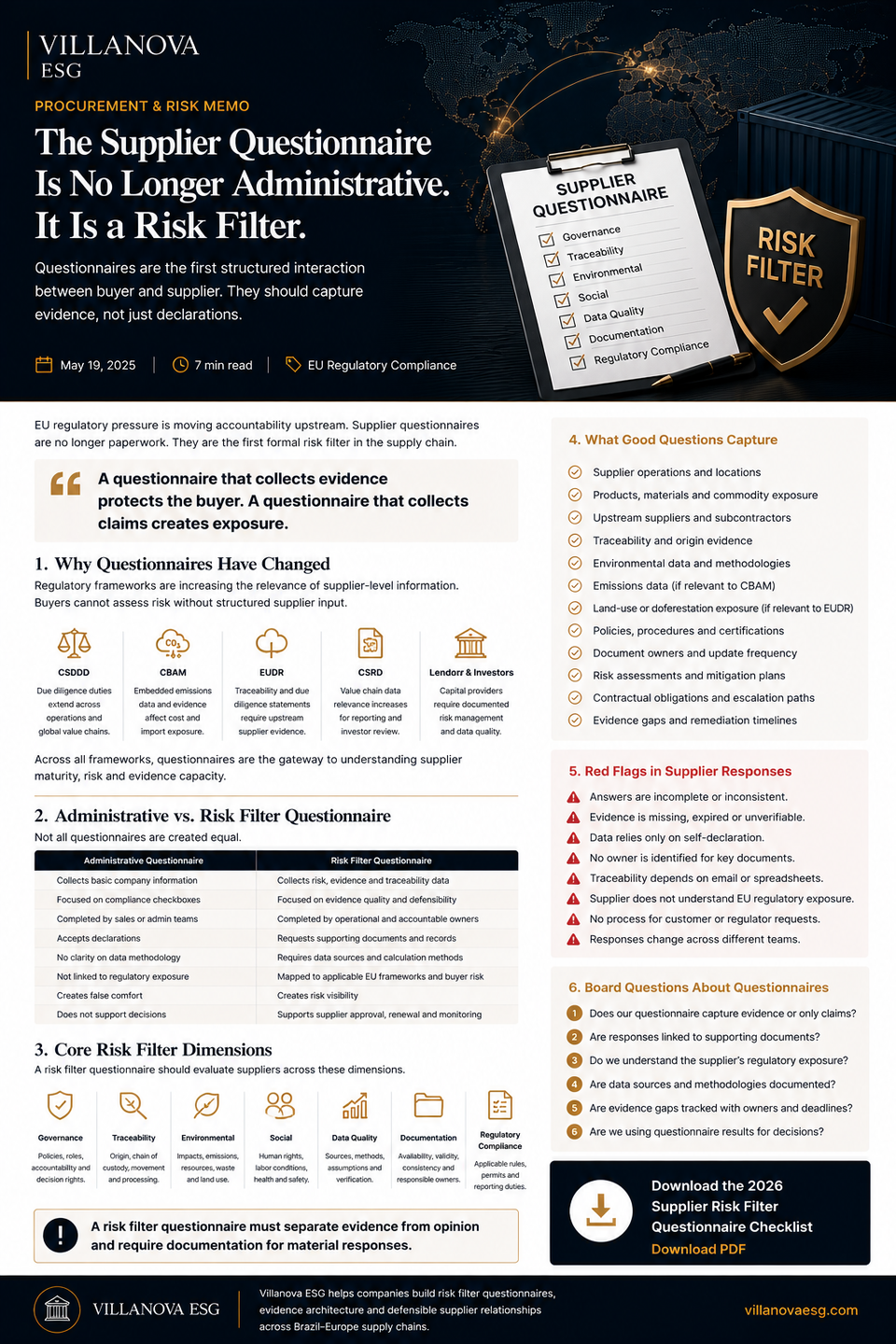
A questionnaire that collects evidence protects the buyer. A questionnaire that collects claims creates exposure.
In regulated supply chains, the supplier questionnaire must function as a risk filter. It must separate evidence from opinion, maturity from intention and traceability from narrative.
Why Questionnaires Have Changed
The Corporate Sustainability Due Diligence Directive entered into force on 25 July 2024. The European Commission states that it aims to foster responsible corporate behaviour across companies’ own operations, subsidiaries and global value chains. That makes supplier-level evidence relevant to due diligence and governance for companies in scope.
CBAM reinforces the need for supplier data quality in covered import categories because the mechanism is designed to confirm that a carbon price has been paid for embedded emissions generated in the production of certain goods imported into the EU.
EUDR adds another layer of traceability discipline for covered commodities and products. The EU Information System allows operators and traders to create and manage due diligence statements.
CSRD also increases pressure on value-chain data quality because companies subject to the directive must report according to European Sustainability Reporting Standards.
Administrative Form vs. Risk Filter Questionnaire
Not all supplier questionnaires create risk visibility. Some only create a false sense of control.
| Administrative Questionnaire | Risk Filter Questionnaire |
|---|---|
| Collects basic company information. | Collects evidence, risk indicators and traceability records. |
| Focuses on checkboxes and declarations. | Requires supporting documents, data sources and methodology notes. |
| Can be completed by sales or admin teams. | Requires input from operations, compliance, legal, finance and technical owners. |
| Accepts generic ESG claims. | Tests whether claims are current, documented and verifiable. |
| Does not map regulatory relevance. | Connects responses to EU frameworks, buyer exposure and supplier continuity risk. |
What a Risk Filter Questionnaire Should Capture
1. Supplier Operations
Locations, facilities, production stages, subcontractors, logistics flows and responsible operational owners.
2. Product and Input Exposure
Products, materials, commodities, inputs, components and categories that may trigger EU regulatory relevance.
3. Traceability Evidence
Origin, chain of custody, movement, processing history, subcontracting records and evidence of control.
4. Environmental and Social Risk
Land-use exposure, emissions data, labor risks, health and safety controls, waste streams and biodiversity relevance where material.
5. Data Methodology
Whether data is measured, estimated, self-declared, third-party verified or based on supplier assumptions.
6. Documentation Governance
Document owners, validity dates, update frequency, evidence gaps, remediation plans and escalation paths.
CFO Formula for Questionnaire Risk
A questionnaire should reduce uncertainty. If it only captures declarations, it increases risk.
Questionnaire Risk = Response Gap × Evidence Weakness × Supplier Criticality × Regulatory Exposure
This formula requires internal buyer data. The CFO needs supplier criticality, product exposure, regulatory category, revenue dependency, documentation maturity, response reliability and replacement lead time.
Supplier Risk Filter Score = Evidence Quality + Traceability + Data Methodology + Governance Ownership − Critical Gaps
If a questionnaire cannot produce this score, it is not a risk filter. It is administrative paperwork.
Red Flags in Supplier Responses
- Answers are incomplete, generic or inconsistent across sections.
- Evidence is missing, expired, unverifiable or disconnected from operations.
- Data is based only on self-declaration without supporting records.
- No document owner is identified for key evidence categories.
- Traceability depends on email chains, spreadsheets or memory.
- Supplier does not understand which EU frameworks may be relevant.
- No process exists for customer, lender, auditor or regulator requests.
- Responses change depending on whether sales, compliance or operations answers the same question.
Board Questions About Supplier Questionnaires
- Does our questionnaire capture evidence or only claims?
- Are responses linked to supporting documents?
- Do we understand the supplier’s regulatory exposure by product, input and geography?
- Are data sources and methodologies documented?
- Are evidence gaps tracked with owners, deadlines and remediation plans?
- Do questionnaire results influence supplier approval, renewal and contract terms?
- Can procurement, legal, finance and compliance defend the same supplier risk profile?
- How fast can the supplier respond to a buyer, lender or regulatory request?
Decision Trigger for Procurement and CFOs
Do not use supplier questionnaires as compliance theater.
Use them to identify evidence gaps, price risk, define contract controls and decide whether the supplier is buyer-ready.
The CFO should treat questionnaire quality as a risk control. If the questionnaire does not reveal exposure before approval, the company will discover the cost later.
Villanova ESG Position
Villanova ESG helps companies transform supplier questionnaires into regulatory risk filters for Brazil-Europe supply chains.
The objective is not to create longer forms or generic ESG checklists. The objective is to design evidence-driven questionnaires that support buyer-readiness, procurement decisions, supplier renewal, contract control and board-level defensibility.
In regulated supply chains, the right question is not whether the supplier can answer. It is whether the supplier can prove.
Regulatory Source Trail
- European Commission — Corporate Sustainability Due Diligence Directive: Directive 2024/1760 entered into force on 25 July 2024 and aims to foster responsible corporate behaviour across companies’ own operations, subsidiaries and global value chains.
- European Commission — Carbon Border Adjustment Mechanism: CBAM is designed to confirm that a carbon price has been paid for embedded carbon emissions generated in the production of certain goods imported into the EU.
- European Commission — EUDR Information System: operators and traders can create and manage due diligence statements through the EU Information System.
- European Commission — Corporate Sustainability Reporting: companies subject to CSRD report according to European Sustainability Reporting Standards.
Executive Review
Turn supplier questionnaires into evidence-based risk filters.
Villanova ESG supports EU buyers and Brazilian suppliers with evidence-driven questionnaires, supplier risk mapping and regulatory defensibility frameworks for cross-border supply chains.
For private board-level briefings: contact@villanovaesg.com