
The CFO Framework for Pricing Regulatory Exposure Into Supplier Contracts
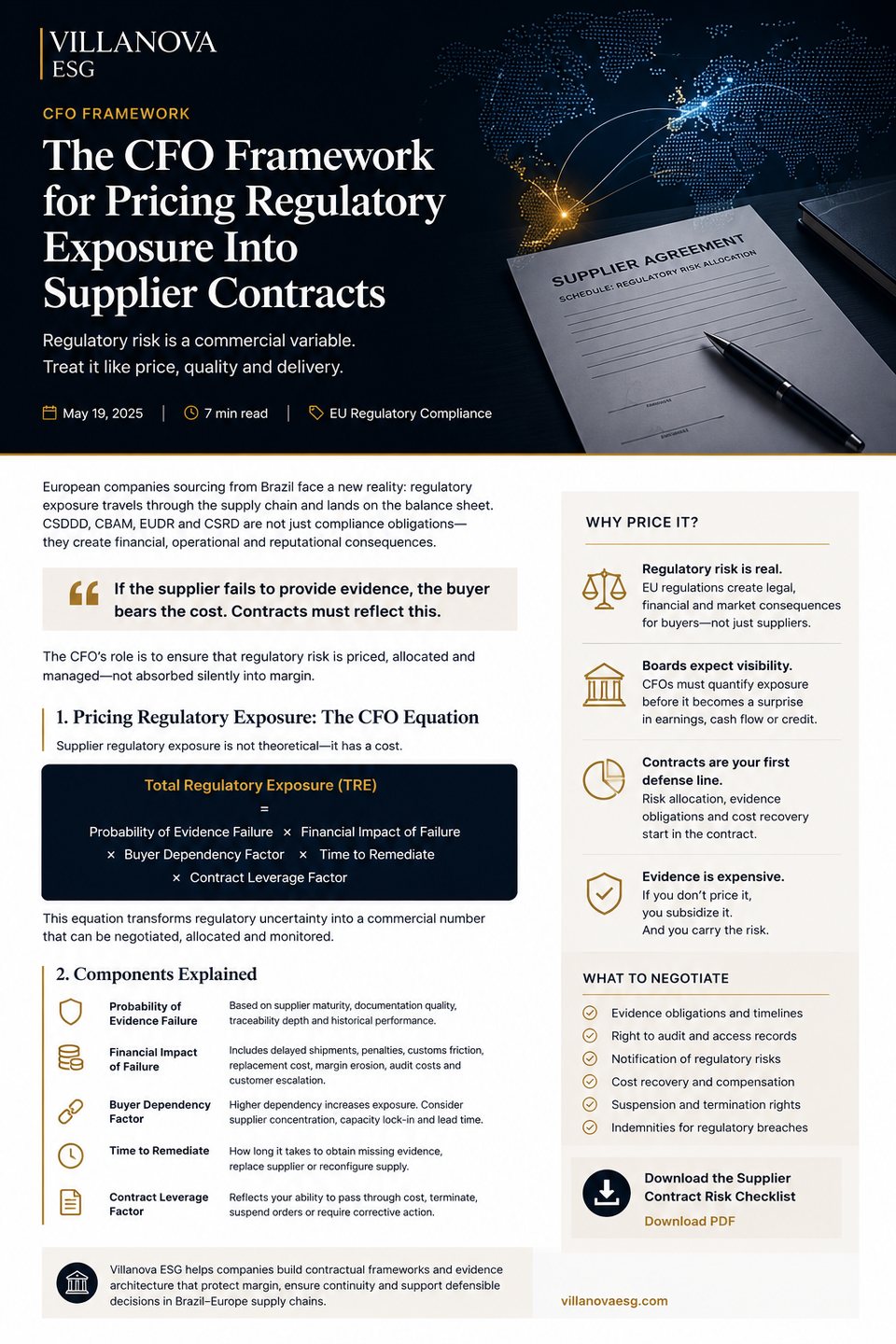
CFO Framework
The CFO Framework for Pricing Regulatory Exposure Into Supplier Contracts
Regulatory exposure is not a legal footnote. It is a commercial variable. CFOs should price it into supplier contracts before it becomes margin erosion, delivery friction or board-level exposure.
Contract Variable
Evidence Risk
Financial Impact
Margin + Cash Flow
Board Lens
Risk Allocation
Executive Thesis
Supplier contracts are no longer only instruments for price, volume, delivery, quality and payment terms. In cross-border supply chains, they are now financial risk allocation tools.
For European companies sourcing from Brazil, the CFO should assume one baseline principle:
If regulatory evidence fails, the buyer may carry the cost before the supplier carries the consequence.
That cost may appear as delayed shipments, customer escalation, customs friction, contract renegotiation, urgent documentation remediation, supplier replacement, audit response, working-capital stress or margin compression.
The commercial question is direct: if the supplier creates regulatory exposure, who pays?
Why CFOs Must Price Regulatory Exposure
The EU regulatory environment is shifting supplier risk from soft compliance language into operational and financial governance.
The Corporate Sustainability Due Diligence Directive entered into force on 25 July 2024 and is designed to address human rights and environmental impacts in companies’ own operations, subsidiaries and global value chains. That places supplier evidence inside a governance architecture, not outside the business model.
CBAM creates a framework for confirming that a carbon price has been paid for embedded emissions generated in the production of certain goods imported into the EU. This means emissions data, supplier documentation and reporting quality can affect import economics.
Under the EU Deforestation Regulation architecture, operators and traders use the EU Information System to submit and manage due diligence statements. That reinforces the commercial relevance of upstream traceability and document readiness.
CSRD also increases disclosure pressure for companies subject to sustainability reporting under European Sustainability Reporting Standards. Value-chain information becomes more relevant to corporate reporting, lender review and investor scrutiny.
The CFO Pricing Equation
Regulatory exposure should be converted into a contract variable. The goal is not false precision. The goal is disciplined pricing logic.
Total Regulatory Exposure = Probability of Evidence Failure × Financial Impact × Buyer Dependency × Remediation Time × Contract Leverage Factor
This formula does not produce a serious output without internal data. A CFO needs supplier concentration, margin contribution, contract value, replacement lead time, evidence maturity, risk category, customer dependency and operational criticality.
Without those inputs, the company is not pricing risk. It is absorbing it.
The Five Contract Variables CFOs Should Control
1. Evidence Obligation
The supplier must provide defined evidence, not generic ESG statements. The contract should specify documents, formats, timing, review rights and update frequency.
2. Cost Allocation
The agreement should define who pays for remediation, re-documentation, third-party review, delayed shipments, reclassification, audit support or regulatory response.
3. Audit and Access Rights
Buyers need the right to review relevant records, request supporting evidence and verify the basis of supplier representations within legally appropriate limits.
4. Continuity Triggers
The contract should define what happens when evidence gaps delay shipments, create customer risk, affect reporting quality or require urgent remediation.
5. Termination or Suspension Rights
If the supplier cannot support regulatory defensibility, the buyer needs clear rights to suspend orders, require corrective action or exit the relationship.
6. Evidence Refresh Cycle
Supplier evidence should not be treated as static. Contracts should require periodic updates when regulation, sourcing, operations or product composition changes.
Contract Pricing Logic
Regulatory exposure can be priced in three ways.
1. Price Discount for Evidence Weakness
If the supplier’s documentation maturity is weak, the buyer may require a commercial discount to compensate for review burden, remediation risk and operational uncertainty.
2. Risk Premium for Buyer Dependency
If the buyer is highly dependent on the supplier, the contract should reflect stronger evidence obligations, continuity planning and cost recovery mechanisms.
3. Step-Up Obligations for Higher Exposure
As regulatory exposure increases, the supplier should face stronger reporting, traceability, audit support, notification and remediation obligations.
Supplier Contract Risk Matrix
| Risk Level | Supplier Condition | Contract Response | CFO Concern |
|---|---|---|---|
| Low | Structured evidence, clear traceability and periodic updates. | Standard evidence clauses and review cycle. | Monitor continuity and reporting quality. |
| Medium | Partial evidence, fragmented files or limited traceability. | Corrective action plan, stronger audit rights and cost allocation. | Price remediation and avoid silent margin absorption. |
| High | Weak documentation, unclear chain of custody or unresolved exposure. | Conditional approval, suspension rights, indemnity and replacement planning. | Protect cash flow, customer commitments and board defensibility. |
What CFOs Should Not Accept
- Supplier contracts with generic ESG language but no evidence obligations.
- Declarations without audit rights, supporting documentation or refresh mechanisms.
- Price negotiations that ignore regulatory remediation cost.
- Procurement approvals without legal, finance and compliance review for exposed categories.
- Supplier questionnaires treated as administrative forms rather than risk filters.
- Contracts that leave all evidence failure costs with the buyer by default.
- Critical suppliers with no replacement economics or continuity plan.
Decision Trigger for CFOs
If the supplier cannot document the risk, the buyer should not carry the cost invisibly.
Price the exposure, allocate the responsibility, define the evidence obligation and protect the exit option.
The CFO should not treat regulatory exposure as a downstream compliance problem. It belongs in the supplier contract before the purchase order is issued.
Villanova ESG Position
Villanova ESG helps companies structure supplier evidence architecture and regulatory risk frameworks for Brazil-Europe supply chains.
The objective is not to provide a legal guarantee or promise regulatory certainty. The objective is to help CFOs, Boards, procurement, legal and compliance teams assess exposure, organize evidence and make supplier decisions with defensibility.
In cross-border supply chains, weak evidence is not only a compliance gap. It is an unpriced commercial liability.
Regulatory Source Trail
- European Commission — Corporate Sustainability Due Diligence Directive: Directive 2024/1760 entered into force on 25 July 2024 and addresses adverse human rights and environmental impacts across operations, subsidiaries and global value chains.
- European Commission — Carbon Border Adjustment Mechanism: CBAM is designed to confirm that a carbon price has been paid for embedded carbon emissions generated in the production of certain goods imported into the EU.
- European Commission — EUDR Information System: operators and traders use the system to submit and manage due diligence statements.
- European Commission — Corporate Sustainability Reporting: companies subject to CSRD report according to European Sustainability Reporting Standards.
- OECD — Due Diligence Guidance for Responsible Business Conduct: reference framework for risk-based due diligence across operations, supply chains and business relationships.
Executive Review
Price regulatory exposure before it becomes margin erosion.
Villanova ESG supports companies building CFO-grade supplier risk frameworks, regulatory evidence architecture and board-level documentation for Brazil-Europe supply chains.
For private board-level briefings: contact@villanovaesg.com