
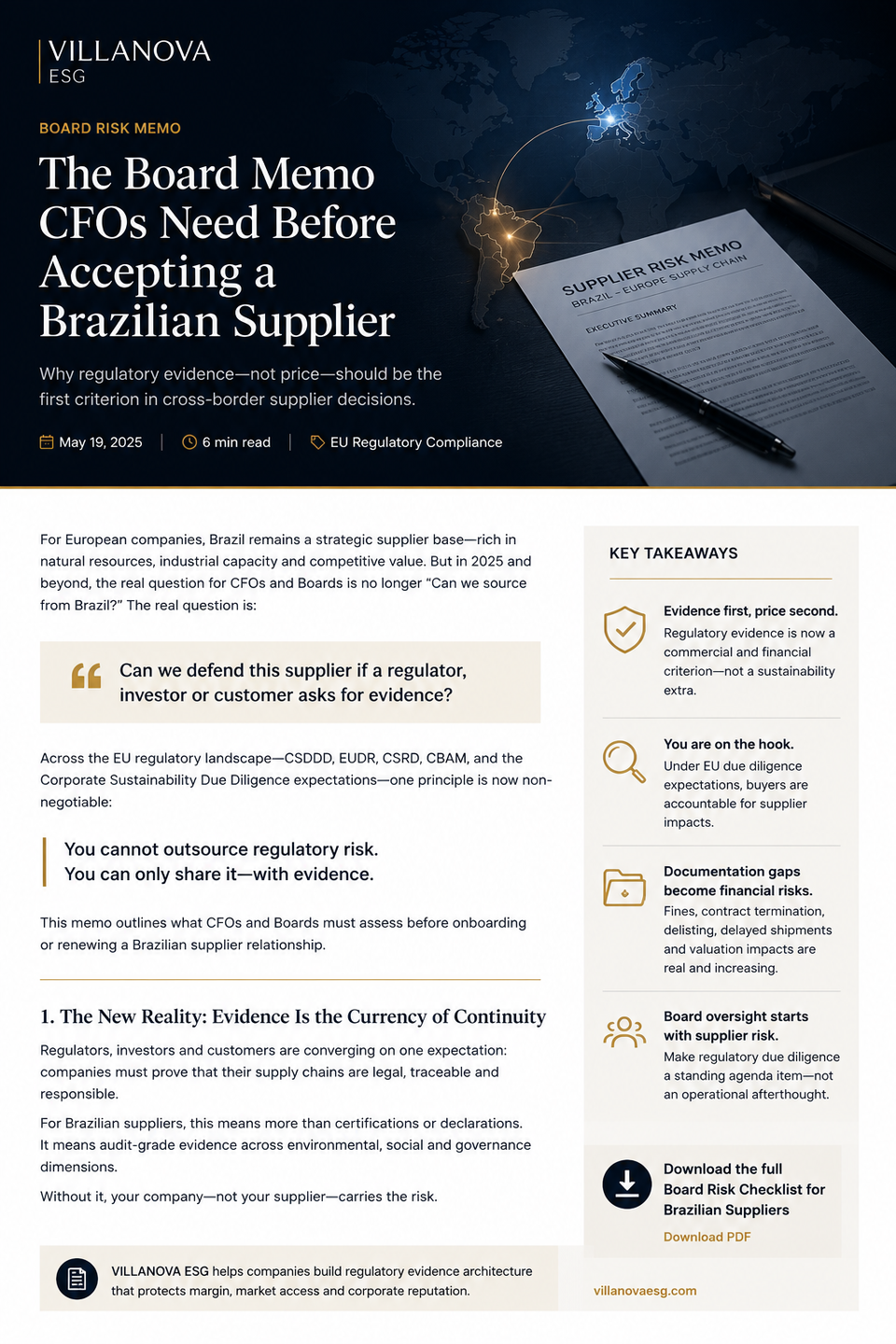
The Board Memo CFOs Need Before Accepting a Brazilian Supplier
Board Risk Memo
The Board Memo CFOs Need Before Accepting a Brazilian Supplier
Price, capacity and delivery terms are no longer sufficient criteria for supplier acceptance. For European companies sourcing from Brazil, supplier approval now requires a defensible evidence architecture.
Risk Category
Supplier Continuity
CFO Exposure
Margin, Delays, Cash Flow
Evidence Standard
Audit-Grade Documentation
Executive Thesis
For European buyers, Brazil remains a strategic supplier base. It offers industrial capacity, natural resources, agricultural relevance, technical capability and competitive production economics.
But the board-level question has changed.
Can we defend this supplier if a regulator, investor, lender, customer or strategic buyer asks for evidence?
That is the question CFOs and Boards should ask before accepting, renewing or expanding a Brazilian supplier relationship.
The answer cannot rely on ESG claims, generic certifications or commercial confidence. It requires a structured evidence file connecting operations, traceability, supplier controls, documentation, environmental exposure and cross-border regulatory relevance.
Why This Became a Board Issue
EU regulation is moving supplier assessment away from narrative and toward documented accountability. The CSDDD entered into force on 25 July 2024 and aims to address human rights and environmental impacts across companies’ own operations, subsidiaries and global value chains. The European Commission has also introduced simplification proposals, but the strategic direction remains clear: value-chain evidence is now part of corporate risk governance.
CBAM has shifted carbon-intensive imports into a reporting and financial exposure framework. The European Commission describes CBAM as a system to ensure that a carbon price has been paid for embedded emissions in certain imported goods. That makes supplier emissions data a commercial variable, not a sustainability narrative.
EUDR implementation also reinforces the same principle: operators and traders must be able to submit due diligence statements through the EU information system to show that relevant products comply with deforestation-free requirements.
CSRD further increases pressure because companies subject to the directive report under European Sustainability Reporting Standards, including sustainability risks, impacts and opportunities connected to their value chains.
The Supplier Acceptance Test
Before accepting a Brazilian supplier, the CFO should require a decision memo covering five evidence layers.
1. Operational Traceability
Can the supplier prove where the relevant input, material, product or waste stream originates, how it moves and who controls each stage?
2. Regulatory Mapping
Which EU frameworks may affect the buyer through this supplier relationship: CSDDD, CBAM, EUDR, CSRD, ESPR or sector-specific requirements?
3. Documentation Quality
Are the documents audit-grade, current, internally consistent and capable of being reviewed by legal, procurement, finance or external auditors?
4. Financial Exposure
What is the potential cost of delay, replacement, customs friction, customer rejection, contract renegotiation or evidence remediation?
5. Board Defensibility
Could the board defend the supplier decision if challenged by a regulator, lender, investor, customer or strategic buyer?
6. Continuity Risk
If the supplier cannot produce evidence, how fast can the company replace, remediate or ring-fence the exposure?
CFO Risk Formula
Supplier risk should be priced before acceptance, not after regulatory friction appears.
Expected Supplier Exposure = Probability of Evidence Failure × Financial Impact of Disruption
The financial impact should include delayed shipments, replacement cost, contractual penalties, customs friction, customer escalation, internal remediation time, legal review, audit response and working-capital stress.
Supplier Acceptance Threshold = Strategic Value − Evidence Gap Cost − Continuity Risk Premium
This model requires internal company data. Without supplier revenue dependency, replacement lead time, margin contribution, evidence maturity and contract exposure, no serious risk quantification is possible.
What the Board Should Ask
- Can this supplier prove operational traceability beyond commercial declarations?
- Which EU regulatory frameworks create direct or indirect exposure for the buyer?
- Does the supplier have documentation that can survive audit, legal review and customer scrutiny?
- What is the cost of replacing this supplier if evidence fails?
- What margin depends on this supplier relationship?
- Has procurement priced the risk of documentation failure into the contract?
- Is the evidence held in a structured evidence room or scattered across emails, PDFs and declarations?
- Can finance, legal, ESG and procurement defend the same version of the supplier risk profile?
Red Flags Before Supplier Approval
A Brazilian supplier should not be treated as board-ready when the following signals appear:
- Documentation is fragmented, outdated or inconsistent.
- Traceability depends on verbal explanation rather than verifiable records.
- Environmental, labor, logistics or waste evidence is not connected to the commercial flow.
- Supplier questionnaires are completed by sales teams without legal, operational or compliance review.
- Documents exist, but there is no evidence architecture explaining how they support the buyer’s exposure.
- Procurement evaluates price before regulatory defensibility.
- The supplier cannot distinguish between marketing ESG and audit-grade evidence.
Decision Trigger for CFOs
Do not accept a supplier because the commercial case is strong.
Accept the supplier only when the commercial case, regulatory evidence and continuity risk can be defended together.
The CFO’s role is not to replace procurement or legal. The CFO’s role is to ensure that supplier acceptance does not create an unpriced liability inside margin, working capital, credit discussions or board governance.
Villanova ESG Position
Villanova ESG supports companies exposed to Brazil-Europe supply chains by translating operational evidence into board-level regulatory documentation.
The objective is not to promise legal certainty, risk zero or guaranteed compliance. The objective is to structure the evidence architecture that allows CFOs, Boards, legal teams, procurement and compliance functions to assess risk with discipline.
In cross-border supply chains, supplier acceptance is no longer a procurement formality. It is a financial governance decision.
Regulatory Source Trail
- European Commission — Corporate Sustainability Due Diligence Directive: Directive 2024/1760 entered into force on 25 July 2024 and addresses human rights and environmental impacts across operations and global value chains.
- European Commission — Carbon Border Adjustment Mechanism: CBAM is designed to ensure that a carbon price has been paid for embedded emissions in certain goods imported into the EU.
- European Commission — CBAM Legislation and Guidance: importers can assess whether goods are subject to CBAM reporting requirements during the transitional framework.
- European Commission — EUDR Information System: operators and traders submit due diligence statements through the EU registry to demonstrate compliance with deforestation regulation requirements.
- European Commission — Corporate Sustainability Reporting: companies subject to CSRD report according to European Sustainability Reporting Standards.
- OECD — Due Diligence Guidance for Responsible Business Conduct: companies are expected to conduct risk-based due diligence across operations, supply chains and business relationships.
Executive Review
Assess supplier evidence before it becomes board-level exposure.
Villanova ESG helps companies structure cross-border evidence architecture for Brazil-Europe supply chains, regulatory defensibility and CFO-grade risk assessment.
For private board-level briefings: contact@villanovaesg.com