
Regulatory Evidence Rooms: The Missing Layer in ESG Due Diligence
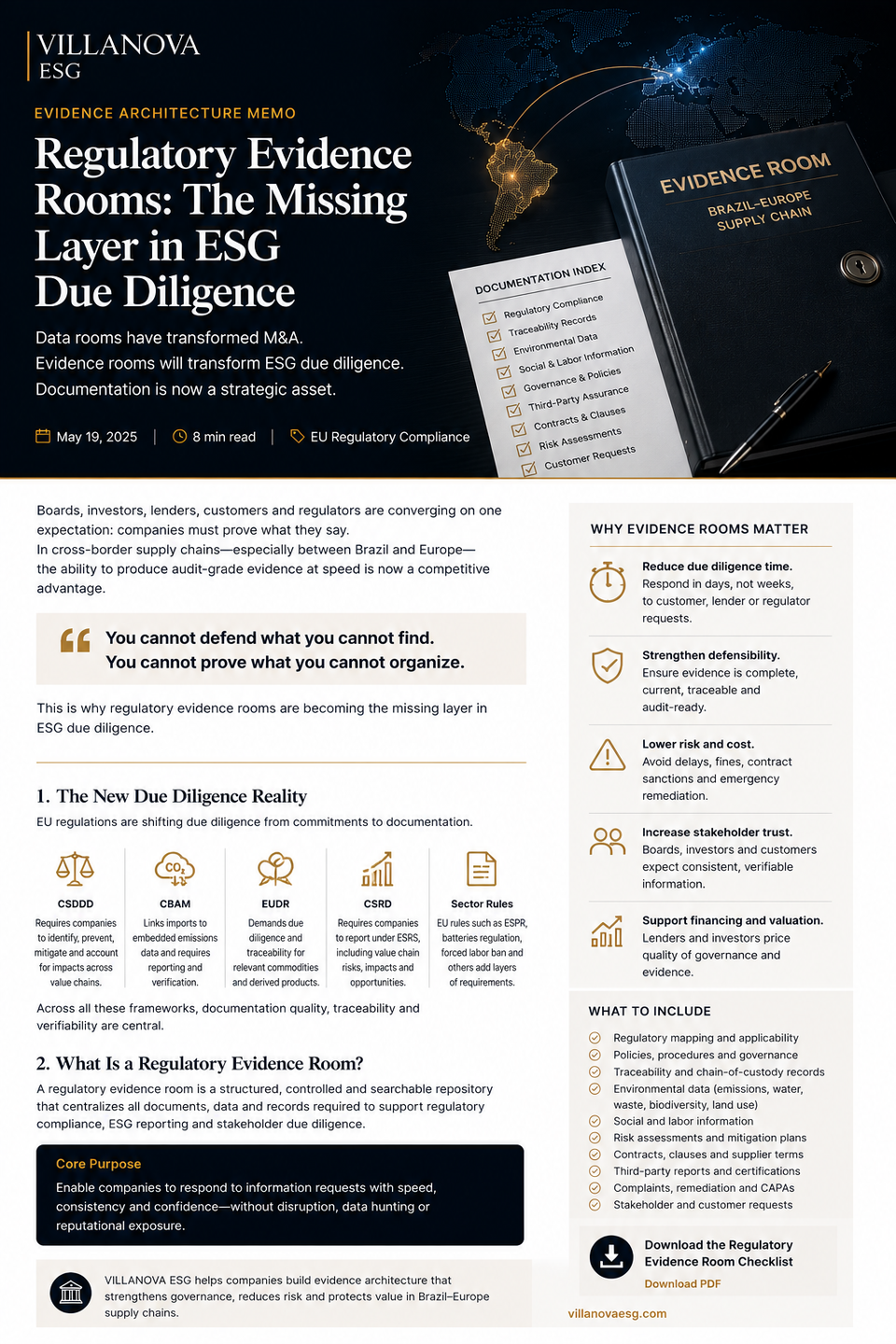
Evidence Architecture Memo
Regulatory Evidence Rooms: The Missing Layer in ESG Due Diligence
Data rooms transformed M&A. Regulatory evidence rooms will transform ESG due diligence. In Brazil-Europe supply chains, scattered documentation is no longer enough.
Due Diligence Layer
Evidence Room
CFO Exposure
Review Speed + Cost
Board Value
Defensible Decisions
Executive Thesis
ESG due diligence often fails for a simple reason: the evidence exists somewhere, but it is not organized, mapped, current or decision-ready.
For CFOs, Boards, investors, lenders and EU buyers, this is not an administrative inconvenience. It is a governance weakness.
You cannot defend what you cannot find. You cannot prove what you cannot organize.
A regulatory evidence room solves this problem by creating a structured repository for supplier documentation, regulatory mapping, traceability records, risk assessments, audit files, contracts, policies, data methodologies and stakeholder responses.
The objective is not cosmetic ESG. The objective is evidence architecture.
Why Evidence Rooms Are Becoming Necessary
The Corporate Sustainability Due Diligence Directive entered into force on 25 July 2024. The European Commission states that the directive aims to foster sustainable and responsible corporate behaviour in companies’ operations and across global value chains, with companies in scope identifying and addressing adverse human rights and environmental impacts inside and outside Europe. This makes value-chain evidence a governance issue, not a communications asset. :contentReference[oaicite:0]{index=0}
CBAM also increases the operational relevance of evidence. The European Commission describes CBAM as a system to confirm that a carbon price has been paid for embedded carbon emissions generated in the production of certain goods imported into the EU. For covered categories, emissions data and documentation quality are no longer peripheral. :contentReference[oaicite:1]{index=1}
OECD guidance reinforces the same discipline. It calls for companies to map operations, suppliers and business relationships connected to prioritized risk, and to catalogue applicable standards, laws and frameworks. That is evidence room logic in operational form. :contentReference[oaicite:2]{index=2}
Evidence rooms reduce response time, improve internal consistency and strengthen the company’s ability to answer regulators, buyers, lenders, investors, auditors and customers without reconstructing the case under pressure.
What Is a Regulatory Evidence Room?
A regulatory evidence room is a controlled, structured and reviewable repository that organizes the documents and data required to support regulatory defensibility.
It is different from a generic folder, ESG archive or shared drive.
| Generic Document Folder | Regulatory Evidence Room |
|---|---|
| Stores files by department or user habit. | Organizes evidence by risk, regulation, supplier, product, asset or decision use. |
| May contain outdated or duplicated documents. | Controls version, validity, owner, review date and document status. |
| Does not explain why a file matters. | Maps evidence to regulatory exposure, contractual obligations and stakeholder questions. |
| Creates delay during audits or buyer requests. | Accelerates response and reduces review friction. |
| Supports storage. | Supports defensible decision-making. |
What the Evidence Room Should Contain
A serious evidence room should be structured around decision use, not document accumulation.
1. Regulatory Applicability Map
A clear map of which EU frameworks may apply to the company, supplier, product, commodity, input, asset or value-chain relationship.
2. Supplier Evidence Files
Supplier-level documentation covering traceability, governance, environmental exposure, data quality, policies, certifications, contracts and corrective actions.
3. Traceability Records
Origin, chain-of-custody, logistics, processing, subcontracting and control documentation for relevant product or material flows.
4. Data Methodology Notes
Methodologies behind emissions data, product composition, land-use information, environmental indicators and supplier-submitted metrics.
5. Risk Assessments
Financial, operational, legal, procurement and continuity risk assessments linked to supplier relationships or regulatory categories.
6. Contracts and Clauses
Contractual obligations, evidence duties, audit rights, remediation mechanisms, cost allocation and suspension or termination triggers.
7. Stakeholder Response Files
Prepared responses for buyers, lenders, investors, auditors, customers, regulators and board committees.
8. Evidence Gap Register
A live record of missing, weak, expired, inconsistent or unverifiable documents, with owner, deadline and remediation priority.
CFO Formula for Evidence Room Value
The value of a regulatory evidence room can be modeled through risk reduction and response efficiency.
Evidence Room Value = Reduced Response Time + Lower Remediation Cost + Reduced Continuity Risk + Improved Financing Readiness
This is not a theoretical metric. It depends on internal company inputs: number of supplier requests, audit frequency, average response time, remediation cost, document failure rate, customer dependency, lender due diligence intensity and supplier exposure.
Evidence Failure Cost = Request Volume × Failure Rate × Remediation Cost × Business Criticality
If the company cannot calculate this, it does not yet have an evidence management problem under control.
The Evidence Room Governance Model
A regulatory evidence room requires governance. Otherwise, it becomes another unmanaged archive.
| Control | Purpose | Board Relevance |
|---|---|---|
| Evidence Owner | Defines accountability for document quality and updates. | Prevents orphaned evidence and unclear responsibility. |
| Validity Control | Tracks expiration, version, review date and evidence status. | Reduces risk of relying on stale documentation. |
| Access Control | Defines who can view, edit, approve or export documents. | Protects confidentiality and audit trail integrity. |
| Regulatory Mapping | Links evidence to legal, reporting, procurement or customer requirements. | Shows why evidence matters to risk decisions. |
| Gap Register | Tracks unresolved deficiencies and remediation owners. | Supports board visibility over unresolved exposure. |
Red Flags in ESG Due Diligence
- Documents are scattered across email, shared drives, local folders and supplier portals.
- No one can identify the current version of critical supplier evidence.
- ESG claims are not connected to source documents or operational records.
- Evidence is stored but not mapped to regulatory exposure.
- Supplier files are incomplete, expired or inconsistent across departments.
- Buyer, lender or auditor requests require emergency internal searches.
- There is no register of evidence gaps, owners, deadlines or remediation status.
- Legal, procurement, finance and sustainability teams rely on different versions of the same supplier story.
Decision Trigger for CFOs
If your company needs days to find evidence, the risk is already active.
Build the evidence room before the buyer, lender, investor, regulator or auditor asks for proof.
The CFO should treat evidence speed as a financial control. Slow evidence increases remediation cost, weakens negotiating position and exposes the company during due diligence.
Villanova ESG Position
Villanova ESG helps companies structure regulatory evidence rooms for Brazil-Europe supply chains, supplier due diligence, lender review, customer requests and board-level documentation.
The objective is not to create cosmetic ESG archives or promise legal certainty. The objective is to organize evidence so that CFOs, Boards, legal teams, procurement and compliance functions can make faster, more defensible decisions.
In serious due diligence, the strongest company is not the company with the best claims. It is the company that can produce evidence with discipline.
Regulatory Source Trail
- European Commission — Corporate Sustainability Due Diligence Directive: Directive 2024/1760 entered into force on 25 July 2024 and aims to foster sustainable and responsible corporate behaviour across companies’ operations and global value chains.
- European Commission — Carbon Border Adjustment Mechanism: CBAM is designed to confirm that a carbon price has been paid for embedded carbon emissions generated in the production of certain goods imported into the EU.
- OECD — Due Diligence Guidance for Responsible Business Conduct: the guidance includes mapping operations, suppliers and business relationships relevant to prioritized risk and cataloguing applicable standards, laws and frameworks.
- OECD — Due Diligence for Responsible Business Conduct: risk-based due diligence helps companies assess and address real and potential negative impacts in operations, supply chains and business relationships.
Executive Review
Build the evidence room before due diligence becomes pressure.
Villanova ESG supports companies with regulatory evidence rooms, supplier documentation architecture and board-level defensibility for Brazil-Europe supply chains.
For private board-level briefings: contact@villanovaesg.com